Lauren O’Connell, PhD (Stanford University)
Ecological resources and the evolution of parent-offspring interactions
4/30/21 @3-4:30pm
Please emal el1417<at>hunter<dot>cuny<dot>edu to attend
Lauren O’Connell, PhD (Stanford University)
Ecological resources and the evolution of parent-offspring interactions
4/30/21 @3-4:30pm
Please emal el1417<at>hunter<dot>cuny<dot>edu to attend
The sick sense is in the nose
Ivan Rodriguez, PhD (University of Geneva)
Sociability offers many advantages, although a major drawback is the increased risk of exposure to contagious pathogens, like parasites, viruses, or bacteria. Social species have evolved various behavioral strategies reducing the probability of pathogen exposure. We found that in rodents, preference toward healthy individuals was dependent on the olfactory system, more precisely on vomeronasal function. We discovered a novel family of vomeronasal sensors, termed formyl-peptide receptors, that respond to disease-related ligands. This receptor family, initially expressed in immune cells during evolution, acquired neuronal specificity in the rodent lineage via two gene shuffling events. This thus corresponds to a switch from sensing pathogens inside the organism to sensing the outside world through the nose, and represents a striking case of neofunctionalization.
To attend, email: el1417 at hunter dot cuny dot edu
Evolution of brain pathways for vocal learning and spoken language.
Eric Jarvis, PhD (Rockefeller University, HHMI)
Email el1417 at hunter dot cuny dot edu for link to seminar
This week, Becky defended her dissertation, “Circuits Underlying Serotonin Mediated Sex Differences in Fear Learning”, with lots of beautiful data, thoughtful experiments, and super interesting findings! Congratulations Becky for a job incredibly well done, and here is to putting everything into a paper!

Very happy to have Central Park nearby to celebrate with the lab, and Nesha Burghardt, Becky’s primary mentor on the project.
Huge congratulations going out to Itamar on his successful Dissertation Fellowship application!
Itamar has been doing some beautiful analyses of behavioral and neural changes after chronic stress. Lots of pretty images and new circuit findings coming soon from that work. Congratulations!

Itamar in behavior & physiology experiment mode

Itamar in workshop mode
Sniffin’ Out Your Friends: Decoding Smell in Ants and Fireflies
Gregory Pask, Ph.D. (Middlebury College)
3:00pm EST
email el1417 at hunter dot cuny dot edu to attend
Do Sharks Sense Pain?
Maria Elena de Bellard, Ph.D. (USC Northridge)
Friday, 3/19, 3:30pm EST
email el1417 at hunter dot cuny dot edu to attend
Hunter Biology Seminar
Schwann cell metabolism and myelin maintenance
Carla Taveggia, Ph.D. (San Raffaele Scientific Institute, Milan)
For Zoom link, please email: el1417 at hunter dot cuny dot edu
Friday, 3/5, 4pm EST
Kelsey Heslin (University of Iowa)
Flexible interval timing in the rat cerebellum and medial frontal cortex
Please email el1417 at hunter dot cuny dot edu to join
Friday, February 26, 3pm EST
Pinar Ayata, Ph.D. (Advanced Science Research Center, CUNY)
Functional States of Microglia and Health and Disease
Please email or DM @ELikhtik to join the seminar via Zoom.
Amanda Russo (SUNY Stonybrook)
Behavioral and Neural Correlates of Individual Variation in Fear Extinction
email el1417 at hunter dot cuny dot edu to join
Our CNC Colloquium is back for the Spring semester.
Friday, 1/29, 3:00 - 4:30pm EST
Long noncoding RNAs and Memory, Timothy Bredy (Queensland Brain Institute)
Please email to attend: el1417 at hunter dot cuny dot edu
We are interested in translating our safety learning work to humans in order to decrease anxiety. To this end, we are collaborating with Dr. Tracy Dennis-Tiwary’s Emotion Regulation Lab . In a new paper, we outline our ideas for how to more seamlessly study the effects of safety learning on anxiety across the species.
Cho, H., Likhtik, E. & Dennis-Tiwary, T.A. Absence Makes the Mind Grow Fonder: Reconceptualizing Studies of Safety Learning in Translational Research on Anxiety. Cogn Affect Behav Neurosci (2021).
In our new review paper, “White Matter Plasticity in Anxiety: Disruption of Neural Network Synchronization during Threat-Safety Discrimination”, we argue that stress- and anxiety-related disorders are associated with altered myelin plasticity. In turn, changes in myelin plasticity, compromise synchronous communication within circuits that are crucial for proper learning of threat - safety discrimination.
Liu J., Likhtik E., Shereen D.A., Dennis-Tiwary T.A., Casaccia P. (2020) White Matter Plasticity in Anxiety: Disruption of Neural Network Synchronization during Threat-Safety Discrimination. Frontiers in Cellular Neuroscience.

Friday, December 4, 3:00 - 4:30 pm
Imaging deep: sensory and state coding in subcortical circuits
Dr. Jan Gründemann (University of Basel)
Email el1417 at hunter dot cuny dot edu to attend
Wednesday, Nov. 25, 3:00 - 4:30pm
Circadian modulation of hippocampal function
Dr. Annalisa Scimemi (SUNY Albany)
Email el1417 at hunter dot cuny dot edu to attend
Friday, November 13, 2020 3:00 - 4:30pm
A Time to Deliver
Dr. Carmel Martin-Fairey (Harris-Stowe State University)
Dr. Martin-Fairey will discuss the roles that genetic and environmental disruptions of circadian rhythms play in risks for preterm birth.
Please email el1417 at hunter dot cuny dot edu to attend
Friday, November 6, 2020, 3:00 - 4:30pm
The Gut-Brain Axis and Reward
Dr. Ivan de Araujo (Icahn School of Medicine at Mount Sinai)
Please email el1417 at hunter dot cuny dot edu for link to attend
Friday, October 16th, 3:00 - 4:30 pm
Vulnerable and Resilient Phenotypes in a Mouse Model of Anorexia Nervosa.
Dr. Nesha Burghardt (Hunter College, CUNY)
Please email el1417 at hunter dot cuny dot edu for link to attend
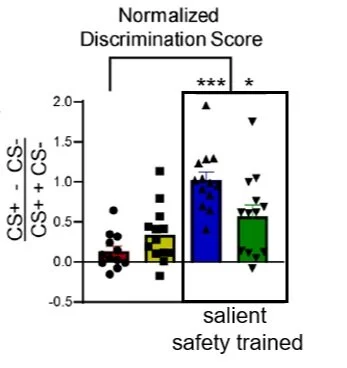
How can we boost the ability to learn about safety? When we amplify the salience of stimuli that signal safety, we improve their effectiveness. But that’s not all - we also improve discrimination of new non-threatening stimuli, and increase exploration of new environments, thereby decreasing generalized fear.
Our new paper is out showing these positive behavioral effects of Salient Safety training in the Safety issue of Behavioural Brain Research.
Nahmoud I., Ganay Vasquez J., Cho H., Dennis-Tiwary T., Likhtik E. (2020) Salient safety conditioning improves novel discrimination learning. Behav Brain Res 397: 112907.